How to Choose Air Compressor for Construction | Full Guide
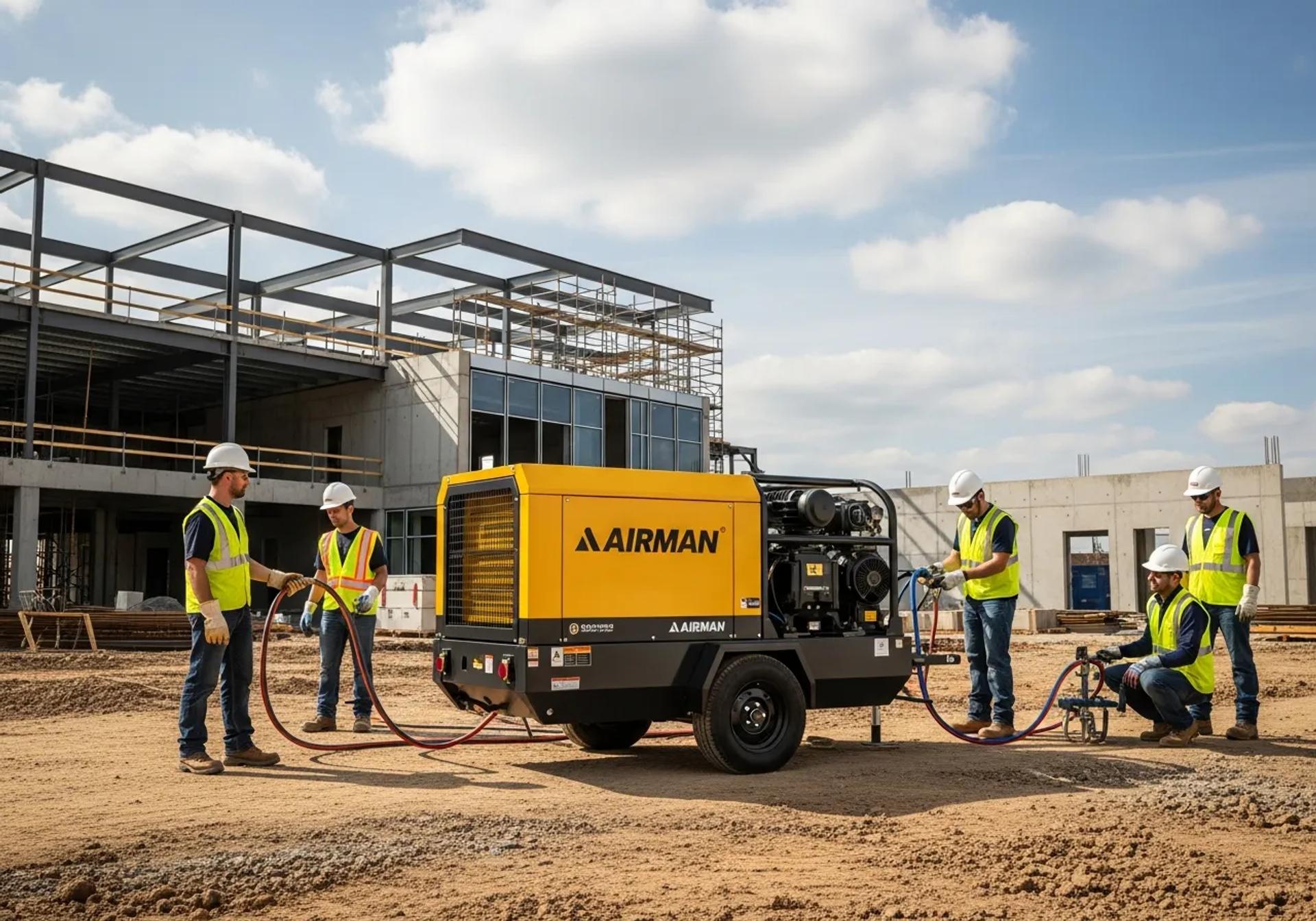
Understanding Air Compressors and Their Critical Role in Industry
An air compressor is the backbone of construction and heavy industrial operations throughout Thailand. This essential equipment pressurizes atmospheric air to power pneumatic tools including air drills, impact wrenches, spray guns, and pneumatic systems in production lines.
The operation of an air compressor relies on fundamental physics principles. The machine draws ambient air, compresses it into a smaller volume to increase pressure, then delivers it to storage tanks or piping systems for distribution to various work points. This process converts electrical or fuel energy into ready-to-use compressed air power.
Industrial air compressors widely used in Thailand come in various brands and sizes, from small units for auto repair shops to large systems supplying entire factories. The key is matching the compressor to your specific work requirements and actual usage needs, as selecting the wrong size or type can lead to efficiency problems and increased operating costs.
Types of Air Compressors Used in Construction and Industry
Before deciding to purchase or rent, it's essential to understand the types and operating principles of air compressors thoroughly, as each type has distinct advantages and limitations.
Rotary Screw Compressors
Rotary screw compressors operate using twin helical screws rotating in opposite directions to continuously compress air. This technology was developed to meet industrial demands for constant air pressure without interruption.
The key advantage of screw systems is their ability to operate at 100% duty cycle, meaning they can run continuously throughout the day without cooling breaks. Operating noise levels range from 65-75 decibels, significantly quieter than piston systems, making them suitable for installation in areas where workers are nearby.
The service life of rotary screw air compressors reaches approximately 40,000-60,000 hours, several times longer than piston systems. While initial costs are higher, when calculating Total Cost of Ownership, they often prove more economical for continuous air usage applications.
Ideal for:
- Industrial plants requiring air throughout work shifts
- Large construction projects demanding high air volumes
- Central air systems for commercial buildings or hospitals
- Production lines requiring constant pressure
Reciprocating (Piston) Compressors
Piston compressors use the same principle as internal combustion engines, with pistons moving up and down within cylinders to draw in and compress air. This proven technology has demonstrated reliability over many decades.
The primary advantage of piston systems is lower initial cost and ease of maintenance. Parts are readily available, and most local technicians can perform repairs. However, these systems have approximately 60-70% duty cycle, requiring cooling periods between operations.
Noise levels for piston air compressors range from 80-90 decibels, which is relatively loud, and service life reaches approximately 10,000-15,000 hours—considerably shorter than screw systems. However, for intermittent use applications, this is adequate.
Ideal for:
- Auto repair shops and general workshop applications
- Small to medium projects
- Intermittent air usage requirements
- Businesses with limited initial budgets
Calculating Air Compressor Size Using CFM
CFM (Cubic Feet per Minute) is the unit measuring air volume a compressor can produce per minute. This is the most critical specification for selecting the right compressor size to match your usage requirements.
The calculation process begins by inventorying all pneumatic tools that will operate simultaneously. Check each tool's CFM requirement from its manual or rating plate, sum all values together, then add 25-30% as a Safety Factor to account for system losses and future capacity needs.
Common CFM requirements include: air drills requiring approximately 4-6 CFM, 1/2-inch impact wrenches needing 4-5 CFM, spray guns requiring 8-12 CFM, air hammers demanding 25-40 CFM, and construction jack hammers requiring up to 70-90 CFM.
Beyond CFM, consider PSI (Pounds per Square Inch) for pressure requirements. Most tools require approximately 90 PSI, though some applications may need up to 150-175 PSI. Your selected air compressor must deliver the pressure your tools require.


Selecting Air Compressors by Application and Industry
Construction and Field Projects
Construction work presents unique challenges including heavy dust exposure, fluctuating temperatures, and frequent equipment relocation. Air compressors for construction must possess several specialized characteristics.
Air filtration systems must be highly efficient, capable of filtering fine dust and particles to prevent internal component damage. Machine frames must be rugged and durable, able to withstand transport impacts, and should include wheels or lifting points for forklift relocation.
Recommended pressure capacity for construction ranges from 125-175 PSI to support heavy equipment like air hammers and jack hammers. Fuel tanks should be large enough for full-day operation without frequent refilling.
Factory and Manufacturing Operations
Industrial air compressors for factories emphasize energy efficiency and operational stability for continuous running, as electricity costs represent the primary expense in compressed air system operation.
Variable Speed Drive (VSD) technology adjusts motor speed according to actual air demand, reducing energy consumption by 30-50% compared to fixed-speed systems. Automatic control systems maintain constant pressure and alert operators when maintenance is due.
IoT connectivity and Remote Monitoring are becoming the new standard for air compressors in modern factories, enabling maintenance teams to monitor equipment status in real-time and plan Preventive Maintenance effectively.
Buy or Rent Air Compressors: A Strategic Business Decision
The decision between buying or renting air compressors has no fixed answer—it depends on each business's context and requirements.
Purchasing suits businesses using equipment daily, with sufficient budget for initial investment, wanting to build fixed assets on their balance sheet, and having maintenance teams or departments capable of self-service. Advantages include no monthly expenses after full payment and the ability to customize or modify equipment as needed.
Renting suits short-term projects with defined timelines, businesses requiring flexibility to change equipment sizes according to workload, or situations where avoiding maintenance responsibilities is preferred. Rental also provides an excellent option for trial use before purchase decisions, ensuring the size and type match actual requirements.
AIRMAN Air Compressor: Japanese Quality Standards
AIRMAN is a leading air compressor brand from Japan, established over 80 years ago with worldwide reputation for durability and performance in construction and industrial applications.
AIRMAN's strengths include high-quality diesel engines that are fuel-efficient and low-emission, multi-layer air filtration systems designed for dusty environments, and robust machine frames built to withstand heavy field use.
Products range from small units for general applications to large units delivering over 1,000 CFM for major construction projects or mining operations.
Namsang Chakkol operates as the authorized AIRMAN distributor in Thailand, providing comprehensive services including new equipment sales, quality used imports from Japan, and both short-term and long-term rental services. Their engineering team and expert technicians are ready to consult on appropriate equipment selection, along with after-sales service and genuine parts support.